Exclusive Arne Jacobsen by Modborn

Exclusive Arne Jacobsen by Modborn

Arne Emil Jacobsen (11 February 1902 – 24 March 1971) was a Danish architect and designer. He is remembered for his contribution to architectural Functionalism as well as for the worldwide success he enjoyed with simple but effective chair designs.

Today, Arne Jacobsen is remembered primarily for his furniture designs. However, he believed he was first and foremost an architect. According to Scott Poole, a professor at Virginia Tech, Arne Jacobsen never used the word 'designer', notoriously disliking it.

His way into product design came through his interest in Gesamtkunst and most of his designs which later became famous in their own right were created for architectural projects. Most of his furniture designs were the result of a cooperation with the furniture manufacturer with which he initiated a collaboration in 1934 while his lamps and light fixtures were developed with Louis Poulsen. In spite of his success with his chair at the Paris Exhibition in 1925, it was during the 1950s that his interest in furniture design peaked.

A major source of inspiration stemmed from the bent plywood designs of Charles and Ray Eames. He was also influenced by the Italian design historian Ernesto Rogers, who had proclaimed that the design of every element was equally important "from the spoon to the city" which harmonized well with his own ideals.

No. 7 chairs in the auditorium of the Ny Carlsberg Glyptotek in Copenhagen

In 1951, he created the Ant chair for an extension of the Novo pharmaceutical factory and, in 1955, came the Seven Series. Both matched modern needs perfectly, being light, compact and easily stackable. Two other successful chair designs, the Egg and the Swan, were created for the SAS Royal Hotel which he also designed in 1956.

Other designs were made for Stelton, a company founded by his foster son Peter Holmbl. These include the now classic Cylinda Line stainless steel cocktail kit and tableware.

Other interior design is a line of faucets and accessories for bathroom and kitchen,created after he won a competition in 1961 for his design of the National Bank of Denmark. This classic design is still in production today by Danish company Vola.

Shop pieces inspired by this style

Every piece below is a Modborn interpretation — styled after the movement, not an official or licensed release.

Grid View:
-5%
Quickview

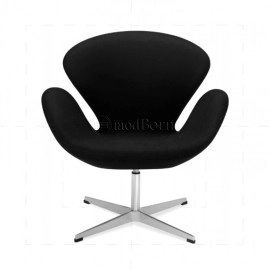
Swan-Style Chair – Black Cashmere Wool

€515.37 €539.97

This piece draws on the Scandinavian modern design tradition — styled in that spirit rather than manufactured or licensed by the original design house.The Swan chair was originally designed in 1958 for the lobby and reception areas at the Royal Hotel in Copenhagen. Swan chair is a true furniture icon of the 20th century.The Swan Chair is synonymous..

-5%
Quickview

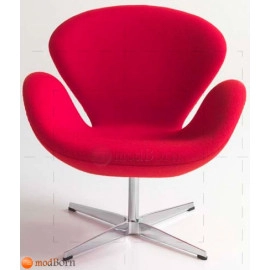
Swan-Style Chair – Red Cashmere Wool

€515.37 €539.97

This piece draws on the Scandinavian modern design tradition — styled in that spirit rather than manufactured or licensed by the original design house.The Swan  chair was originally designed in 1958 for the lobby and reception areas at the Royal Hotel in Copenhagen. Swan chair is a true furniture icon of the 20th century.The Swan Chair is synonymou..

-2%
Quickview

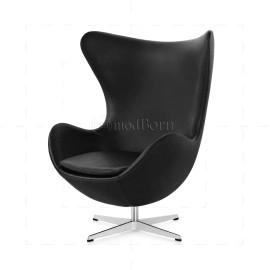
Egg-Style Chair – Black Leather

€1,388.67 €1,413.27

This piece draws on the mid-century modern design tradition — styled in that spirit rather than manufactured or licensed by the original design house.The Egg is a chair designed by a famous designer in 1958 for the Radisson SAS hotel in Copenhagen, Denmark. It is manufactured by Republic of Fritz Hansen. The Egg was designed in a typical contempora..

-4%
Quickview

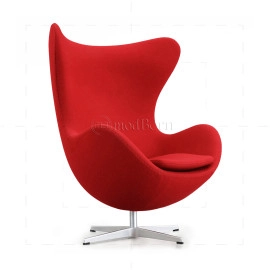
Egg-Style Chair – Red Cashmere Wool

€982.77 €1,019.67

This piece draws on the mid-century modern design tradition — styled in that spirit rather than manufactured or licensed by the original design house.The Egg is a chair designed by a famous designer in1958 for the Radisson SAS hotel in Copenhagen, Denmark. It is manufactured by Republic of Fritz Hansen. The Egg was designed in a typical contemporar..

Showing 1 to 4 of 4 (1 Pages)